
From Manual Configuration to Intelligent Synchronization: How Automation Tools are Reshaping Your Digital Marketing Workflow
From Manual Configuration to Intelligent Synchronization: How Automation Tools are Reshaping Your Digital Marketing Workflow
If you're responsible for managing multiple Facebook ad accounts, the action of "switching IP addresses" is likely very familiar. It used to be a redundant and risky daily operation, repeated dozens of times. A single incorrect IP address could lead to an account being banned, rendering months of operational effort useless. In the realm of digital marketing, we strive for growth and efficiency, yet we are often bogged down by such basic technical details. Today, I want to share our true journey of transforming this aspect of work from a "risk center" to an "efficiency engine" with the help of automation tools.
The Realistic Dilemmas and Efficiency Bottlenecks of Multi-Account Management
In the globalized digital marketing environment, operating teams managing multiple Facebook ad accounts has become the norm, whether for testing different markets, mitigating policy risks, or conducting A/B tests. However, this brings a core technical challenge: account security isolation. The platform's risk control system closely monitors login IPs, device fingerprints, and other data. If associated accounts are identified, they face the risk of collective suspension.
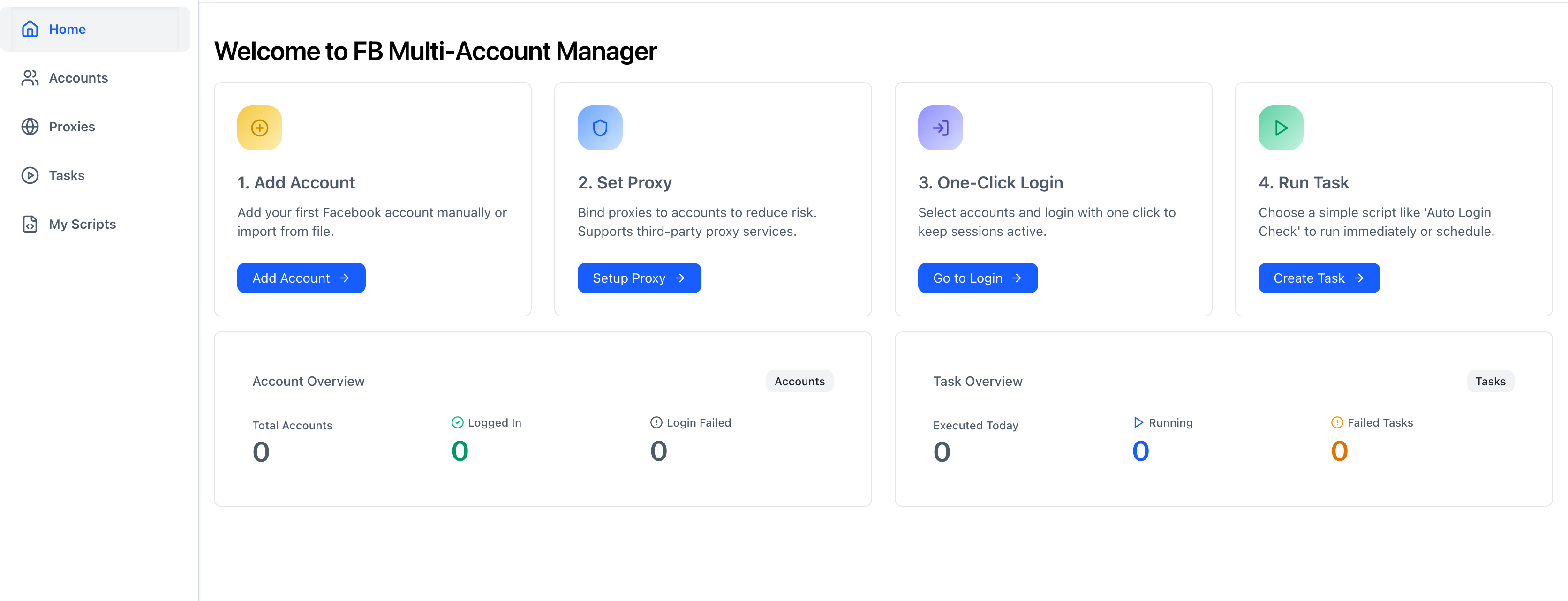
Therefore, binding each ad account to an independent, stable, and clean proxy IP has become an industry standard operation. But it is precisely this "standard operation" that constitutes the biggest efficiency black hole in the workflow. Imagine this scenario: a team member needs to log into a certain account. They must first find the corresponding IP address, port, username, and password from a spreadsheet, and then manually input the configuration into a browser or software. This is not only time-consuming but also prone to errors. When you have ten, fifty, or even hundreds of accounts to manage, this manual configuration model becomes unsustainable.
Limitations and Potential Risks of Traditional Proxy Management Models
In the past, we've tried various methods to address this issue. The most common ones included using shared proxy list documents or deploying local proxy clients for manual switching. While these methods seemed direct, they hid multiple limitations:
- Extremely Inefficient: Repetitive, mechanical manual input consumed a significant amount of time that should have been dedicated to strategy thinking and creative optimization.
- High Error Rate: Human operation is inevitably prone to mistakes. Typing in a wrong number could render an IP unusable, or worse, lead to logging into a sensitive account with the wrong IP.
- Difficult Collaboration: When teams share proxy lists, it's hard to synchronize the status of IP activation, retirement, or replacement in real-time, leading to conflicts.
- Questionable Security: Once a static IP is flagged by the platform, it needs to be replaced promptly. The response speed under manual management is slow, resulting in a long risk window.
What's even more frustrating is that as the team grows or the number of accounts surges, the maintenance cost of this system rises exponentially. We realized that consuming valuable human resources on repetitive technical execution is a massive waste of the team's professional value. The market changes rapidly, but our response speed was stuck at the most basic technical link.
Finding a Breakthrough Point: The Inevitability of Automation and Deep Integration
The solution began to crystallize: we had to upgrade proxy IP management from "manual operation" to "infrastructure." It should be like water and electricity – stable, reliable, and available on demand, without the need to worry about the complex pipelines behind it. This means proxy services need to achieve deep integration and automated synchronization with our core operational platforms.
An ideal solution should possess several key features: Firstly, the proxy IPs themselves need to be of high quality, including high anonymity, stability, and broad geographical distribution, which are the cornerstones of security. Secondly, stable and reliable API interfaces must be provided to allow programmatic calls from other systems. Finally, and most importantly, it needs to achieve seamless integration with the multi-account management platforms we use daily, realizing "one-click synchronization" of configurations and completely eliminating manual steps.
This is not just an efficiency tool; it's an evolution of workflow architecture. When automated management becomes the industry standard, competitive advantage will no longer come from who can "work harder" manually, but from who can integrate resources more intelligently and unleash creativity.
The Value of Tools Lies in Seamless Integration into Scenarios: Taking IPocto and FBMM Integration as an Example
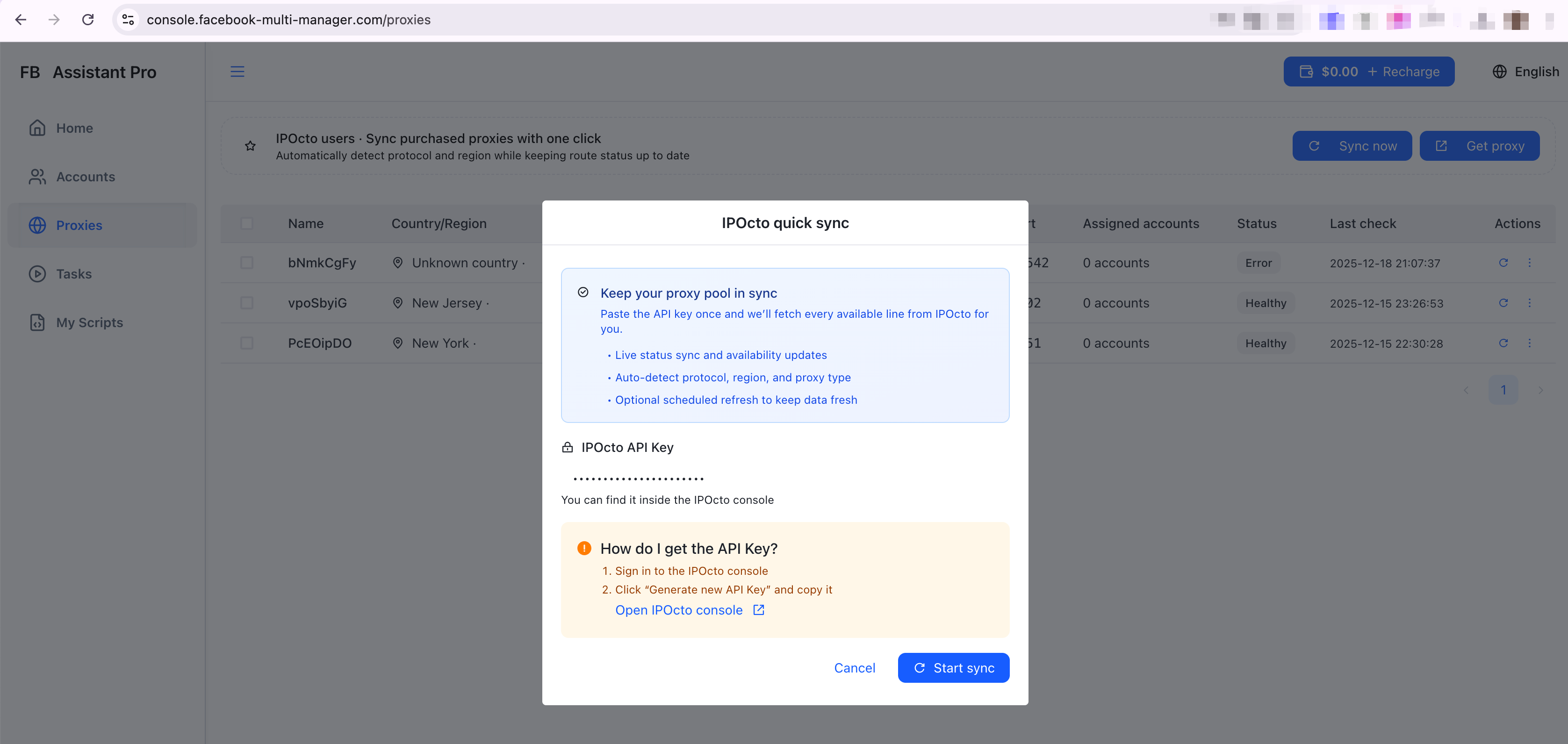
In our exploration, we found a combination that put this idea into practice: the deep integration of Facebook Multi Manager (FBMM) and IPocto. The value of this solution does not lie in the powerful functionality of individual tools, but in how perfectly they are embedded into our workflow, solving the core pain points mentioned earlier.
IPocto, as a professional global proxy service provider, offers stable and clean residential IP resource pools, providing a fundamental guarantee for account security. Its key empowerment lies in its open integration capabilities. FBMM, a platform focused on improving the efficiency of Facebook multi-account management, was designed to simplify all complex operations. When it integrates IPocto's proxy services, a remarkable "chemical reaction" occurs.
The real change lies in the "one-click synchronization" function. This means we don't need to switch back and forth between the FBMM and IPocto control panels, nor do we need to copy and paste any strings. The proxy packages configured by the administrator on IPocto can be directly and automatically synchronized to the FBMM platform and assigned to specific team members or ad accounts. IP management (purchase, replacement, assignment) and IP usage (login, account operation) are perfectly decoupled yet intelligently connected.
The Reshaped Workflow: A Comparison of Actual Scenarios
Let's use a specific scenario to feel the stark difference between before and after automated integration.
Old Workflow (Manual Configuration Era):
- New employee A needs to manage 5 Facebook accounts for the German market.
- Operations manager B needs to log into IPocto, purchase 5 German residential IPs, and record 5 sets of login information.
- B copies the information to the company's shared spreadsheet and notifies A.
- A logs into FBMM and manually enters 5 different sets of proxy information into the configuration fields for the 5 accounts.
- During the process, A might mistype a port number, causing one of the IPs to fail to connect, requiring repeated checks and debugging.
- A week later, one of the IPs becomes invalid, and B and A need to repeat steps 2-4 to replace it.
New Workflow (One-Click Synchronization Era):
- Manager B configures a package of 5 dynamic residential IPs on IPocto for the "German Market Group."
- On the FBMM platform, B directly synchronizes and assigns the "German Market Group" IP package to employee A.
- Upon logging into FBMM, A can directly see that the accounts under their name are automatically configured with usable German IPs and can start working with a single click.
- When the IPs on IPocto are automatically rotated or updated, the configurations on FBMM also automatically synchronize and update, seamlessly.
The efficiency improvement brought about by this shift is astonishing. Tasks that once took hours or even days for configuration are now reduced to minutes. More importantly, it eliminates the possibility of human error and completely liberates team members from technical chores. According to our actual calculations, the overall operational efficiency in account configuration, team collaboration, and fault response has increased by over 300%. This is not an exaggeration but the inevitable dividend released by automating repetitive labor.
To more clearly illustrate the core differences between the two modes, please refer to the table below:
| Comparison Dimension | Traditional Manual Configuration Mode | FBMM + IPocto One-Click Synchronization Mode |
|---|---|---|
| Configuration Speed | Several minutes per account, prone to errors | Minutes for bulk accounts, zero errors |
| Team Collaboration | Relies on documents, information is lagged and prone to conflicts | Clear permissions, real-time synchronization |
| Maintenance Cost | High (manual tracking, replacement) | Low (automatic synchronization, alerts) |
| Risk Control | Slow response, long risk window | Instant synchronization, controllable risk |
| Scalability | More accounts lead to more chaotic management | Account growth does not increase management complexity |
Conclusion: Focus on Core Value, Let Tools Serve You
The core of digital marketing will always be strategy, creativity, and data insights. Any repetitive technical burden that deviates from this core should be handled by automation tools. The deep integration of FBMM and IPocto is a perfect embodiment of this philosophy. It does not replace human work but allows us to focus more on "advertising operations" by automating and centralizing the "IP configuration" step.
The value of this "double-sword combination" lies in reshaping the architecture of the entire workflow. It tells us that future competitiveness comes from intelligent integration and optimization of the work chain. When you are no longer troubled by IP addresses, you will have more energy to think about audience targeting, ad copy, and conversion optimization. This is the greatest gift tools can bring us: returning time to creativity.
Frequently Asked Questions FAQ
Q1: Is this one-click synchronization function applicable to teams of any size? A: Yes, its value varies slightly for teams of different sizes. For small teams or individuals, it greatly simplifies operations and avoids configuration errors. For medium to large teams, its value lies in efficient resource allocation, unified strategy execution, and significantly reduced collaboration costs. The larger the scale, the more significant the efficiency gains.
Q2: Does the IP anonymity and security be guaranteed when using this integrated solution? A: This is fundamental. IPocto provides high-anonymity residential proxies, designed to cope with the strict risk controls of platforms like Facebook. The one-click synchronization function only changes the way IPs are configured and managed, not the quality of the IPs themselves. High-quality, clean IP resources remain the cornerstone of the entire solution's safe operation.
Q3: If the IPs on IPocto are changed, do the accounts in FBMM need to be reconfigured? A: No. This is one of the core advantages of deep integration. When IPocto updates or automatically rotates IPs on its server, the FBMM platform automatically synchronizes this change via API. The proxy connection information assigned to the accounts is automatically updated, ensuring business continuity and delivering true maintenance-free operation.
Q4: Besides Facebook advertising management, can this approach be applied to other scenarios? A: Absolutely. The core idea is "automating the integration of proxy infrastructure with business operation platforms." Any domain that requires multi-account and IP isolation, such as social media marketing, e-commerce reviews, data scraping, SEO monitoring, etc., can benefit from this model. The key is to find proxy service providers that support deep integration, like IPocto, and connect them with your core business platform.